

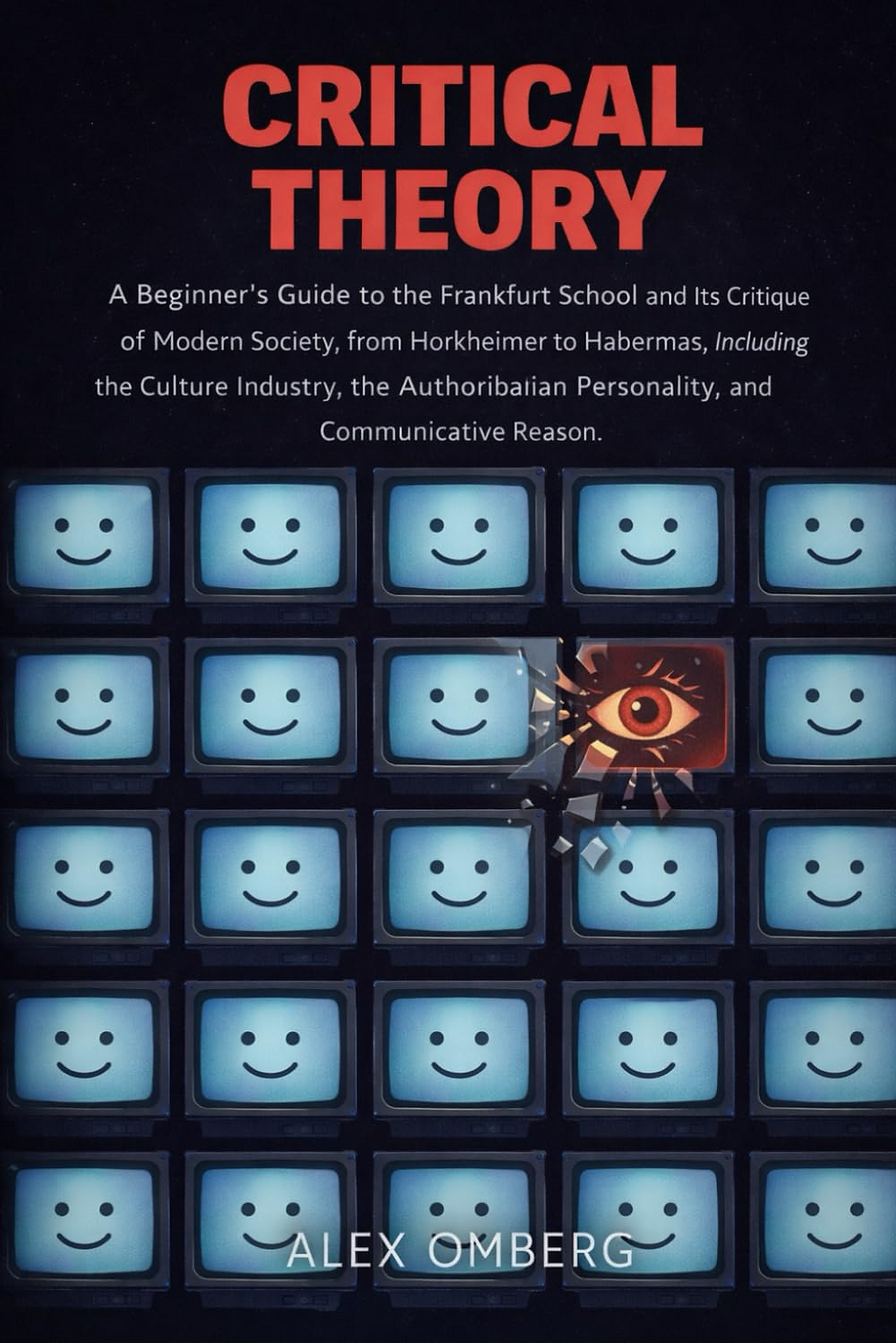
Review: The Book, Critical Theory: A Beginner's Guide to the Frankfurt School and Its Critique of Modern Society...

What do you get when you ask a question? A response? A blank look? Another question? A solution? A map to progress, perhaps? Do the responses, answers, solutions, and such cover everything? Does this entire process end?
No, it does not.
Ever since Socrates started asking probing questions which—and I’m taking quite a shortcut here—transformed into the five interrogatives we use today, questions have always been around. But one of the compelling questions of these, err, questions asks, “Are we ready for the answers?”
Critical Theory: A Beginner's Guide to the Frankfurt School and Its Critique of Modern Society…, by Alex Omberg, provides a detailed albeit brief chronicle of critical theory’s one hundred-plus-year history. With roots in the Enlightenment (1637-1789), critical theory posits philosophical and sociological questions centered on modern capitalism, fascism, and mass culture through an interdisciplinary lens. It is also a social framework that examines hidden power structures, inequality, and dominant ideologies to promote social change and human freedom.
Founded in 1923 at the Institute for Social Research at the University of Frankfurt, Germany, critical theory started categorizing Marxist and Freudian frameworks into a single discipline. Early key thinkers include Max Horkheimer, who defined “traditional theory”—which assumes a neutral, objective stance that actually legitimizes status quo and social inequalities; Theodor Adorno, who posits that modern capitalism maintains oppression through culture and instrumental reason; Herbert Marcuse who, through his works, defined the One-Dimensional Man (1964), presented Eros and Civilization (1955), and coined the term, Repressive Tolerance (1965).
With Horkheimer, “traditional theory” precedes “critical theory.” Rooted in science and Enlightenment rationality, “traditional theory” treats facts as objective and value-free. Horkheimer argues that this supposed neutrality ultimately reinforces the political and economic status quo. His “critical theory,” on the other hand, recognizes that all knowledge is shaped by social and historical forces, with both the observer and the facts influenced by human activity and power dynamics. Adorno’s critical theory critiques modern capitalism, arguing that domination works not only through force but also by shaping people’s thinking and mass culture.
In One-Dimensional Man, Marcuse argues that consumerism and mass media create the illusion of freedom while encouraging conformity and discouraging opposing ideas. Where capitalism provides enough comforts and distractions to keep people content and less likely to challenge deeper social oppression, Marcuse calls it “repressive satisfaction.” His critical approach, the “Three Cs,” involves comprehending how society works, criticizing its systems of domination, and constructing better alternatives for human happiness.
One of the later thinkers—and one whose theories I wholeheartedly agree with—is Jürgen Habermas. His theories break down into communicative action and rationality, the public sphere and democracy, and modernity. For Habermas, communicative action means that human interaction is primarily about reaching mutual understanding rather than simply achieving personal goals. He critiques modern society for allowing technical efficiency and economic interests, or “instrumental reason,” to dominate everyday life. In a concept he calls “Colonization of the Lifeworld,” human relationships turn into commodities and bureaucratic procedures when administrative and economic systems intrude upon everyday cultural life. But his most lasting legacy is the concept of “The Public Sphere.” In his early work, The Structural Transformation of the Public Sphere, Habermas traces the rise of public spaces for open, critical debate and their later decline under mass media and commercialization. He envisions an ideal form of communication where everyone can speak equally, free from outside pressure or hidden power, with the strongest argument carrying the most weight.
Current critical theory expands upon the originals. Contemporary thinkers like Michel Foucault view that “power is everywhere—baked into language, institutions, and knowledge,” while Mark Fisher and Slavoj Žižek critique modern “capitalist realism,” the widespread belief that capitalism is the only workable system and that no real alternative can be imagined. Byung-Chul Han’s “achievement society” contends that people willingly exploit themselves under the illusion of freedom and digital connectivity. Charles Mills and Kimberlé Crenshaw expand critical theory by examining how race, gender, and class intersect to reinforce modern systems of power and inequality.
One of the most disturbing questions that stays with me concerns Auschwitz, a Nazi death camp where Jews and other “Others” were systematically executed. For all intents and purposes, Germany appeared to be a progressive nation when Naziism took root in the 1920s. The question is this: How can this happen in a modern, industrialized, and bureaucratized nation? Critical theorists, especially Max Horkheimer and Theodor Adorno in Dialectic of Enlightenment, argue that the same systems driving modern progress also made industrialized mass murder possible. Modern society often prioritizes “how” to do things over “why,” allowing efficiency to replace moral reflection and turning even mass murder into a technical problem to solve. While the Enlightenment sought to master nature through science and reason, critical theory argues that this desire for control eventually turned toward society itself, enabling the administration and domination of human beings. People were reduced to numbers, data, and economic inputs, stripping away their humanity and making genocide easier to organize and carry out.
It’s chilling how many of the above concepts ring true today in our current political climate.
All in all, I will continue to ask questions, pursue critical theory self-study, and, ultimately, learn to view the world and seek ways to change it for the better. Furthermore, I think many of us should read this book and become more critical of our society and our world. Are we ready for answers to questions that criticize and seek to correct inequalities and wrongdoings? I hope so.


Comments