

Review: The Film, North by Northwest...

Do you remember when intermissions occurred in films longer than two-and-a-half hours? I may be revealing my age here, but movies from the mid-to-late 20th century certainly included them. But then the almighty buck prevailed: to allow more screenings in cinemas, the use of intermissions in longer films stopped altogether.
Why am I even bringing something like this up in my review of North by Northwest (1959)? Comparing this concept to one element—or, more precisely, one scene—in the film leads me to an inevitable conclusion: film editing works wonders, especially when it is unquestionably necessary. I’ll get more into this later.
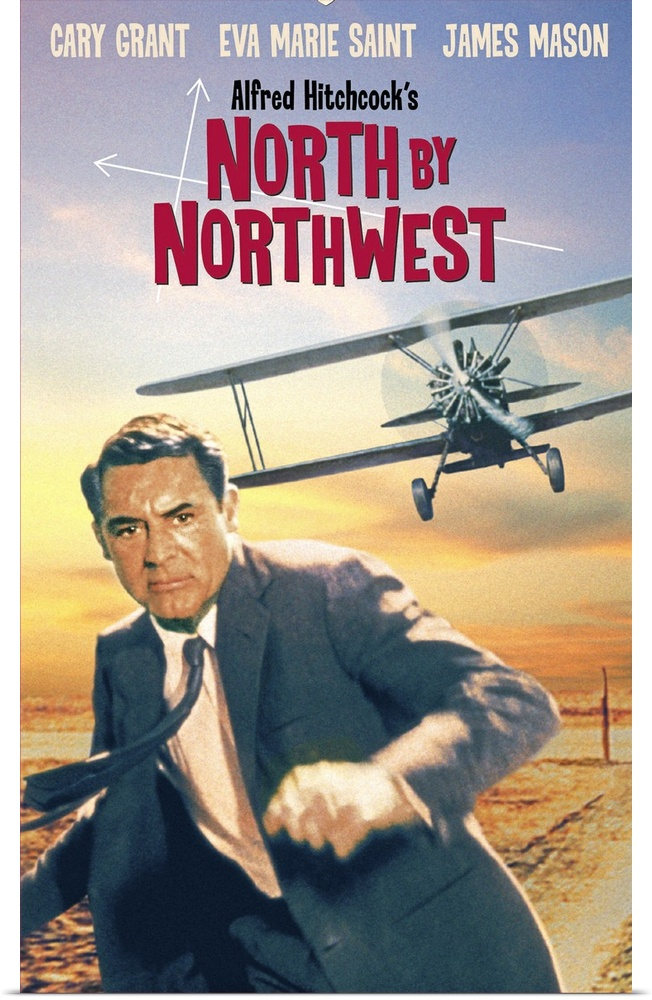
In New York, advertising executive Roger Thornhill (Cary Grant, His Girl Friday) is wrongly identified as a government agent and chased across the nation by foreign spies. During his journey, he encounters the enigmatic Eve Kendall (Eva Marie Saint, On the Waterfront), culminating in an exhilarating finale on Mount Rushmore. Thornhill faces many obstacles along the way, including being framed for murdering a United Nations diplomat, evading attacks of a crop duster with a mounted gun, and allying with an unknown American spy agency.
In this film, Alfred Hitchcock's (Vertigo) direction, drawing from a script by Ernest Lehman (West Side Story), subverts classic film noir conventions with an innocent protagonist rather than a redemption-seeking detective. The film also upends the femme fatale trope and cleverly plays with—or, more accurately, diminishes—the traditional MacGuffin. NBN switches the usual film noir settings of nighttime, rain-soaked city streets, and shadows. Rather than creating a cynical, hopeless atmosphere, the film is lively, fast-paced, and often humorous, serving as a stylistic blueprint for the lighter, globe-trotting James Bond escapades rather than a dark underworld drama.
Just when you thought Bogey and Bacall could light up a screen with their tangible chemistry, Grant and Saint offer their own fireworks. The characters’ quick banter and strong chemistry fuel the film’s romantic tension. Despite the twists and turns of their relationship during the film, you’ll find yourself rooting for them. Their love scenes cleverly skirt 1950s censorship regulations through skillful acting and suggestive performances, while their shared sense of humor lightens the dangerous spy plot and gives the film its playful romantic tone. James Mason (Lolita) portrays Phillip Vandamm with a polite, soft-spoken manner and chilling calm that makes him a formidable villain. Martin Landau (Crimes and Misdemeanors) delivers a breakout performance as Vandamm’s devoted right-hand man Leonard, defined by quiet menace, sharp tailoring, and subtle jealousy toward Eve Kendall.
Hitchcock explores themes of mistaken identity, paranoia, deception and performance, and composure versus chaos. Thornhill's entire experience starts when he is wrongly recognized as a non-existent government agent. He faces this ordeal alone, caught between a foreign spy organization and government officials who offer him no protection, leaving him isolated from society. Characters constantly assume different roles, from intelligence operatives and deceptive lovers to ordinary people hiding their true selves behind facades of normalcy. Thornhill’s iconic gray suit reflects his refined composure amid the absurd violence and chaos of the American landscape.
Notable themes throughout Hitchcock films include the wrong man plot device, voyeurism and surveillance, empty MacGuffins, and the Icebox Blonde. All of these are evident in NBN. Thornhill is the Hitchcockian innocent protagonist forced to clear his name. Thornhill spies on Vandamm, Leonard, and Eve near the film’s conclusion, processing information and crafting a desperate last-minute rescue plan. Eve Kendall, as the Icebox Blonde, is the sophisticated, composed, and graceful female lead character who uncovers profound layers within herself. The MacGuffin here is a plot-driving object or secret whose actual significance matters little to the story.
Critics often cite the film’s absurd plot logic, meaningless MacGuffin, questionable character motivations, and dated gender dynamics. Some of Roger Thornhill’s actions, such as grabbing the knife at the United Nations, defy logic and seem designed primarily to create immediate danger. Critics also note that characters often behave irrationally simply to move the story from one action sequence to the next. The MacGuffin—the unspecified spy secret—has little significance, making the central conflict feel shallow compared with more psychological thrillers. Hitchcock called the microfilm containing state secrets his “purest” and “emptiest” MacGuffin—a meaningless device that drives the mistaken-identity plot while remaining irrelevant to the audience.
Viewed through a feminist critical lens, the film reveals a tension between 1950s patriarchal expectations and Eve Kendall’s intelligence, independence, and agency. She is not a submissive damsel in distress; instead, she functions as a composed, sexually self-assured double agent within a dangerous espionage network. Regarding toxic masculinity, Thornhill begins as an emotionally detached advertising executive who patronizes his female secretary and treats women as conquests. Stripped of his Madison Avenue status and mistaken for a federal agent, Thornhill is forced into a vulnerable, reactive role, repeatedly relying on a woman for help and subverting the traditional tough-guy hero archetype.
To address the initial point I made in this review, there’s a part of one scene in NBN that really should have been edited out. A portion of the scene in the airport with Thornhill and Leo G. Carroll’s (Strangers on a Train) The Professor includes dialogue that is completely muted by plane engine sounds. (I wonder how this is handled when subtitles are used). The reasons given are to avoid redundancy—well, duh, isn’t that what an editor is supposed to do?—subvert exposition—whatever the hell that means—and add realism and atmosphere–having said engine sounds play underneath the dialogue would be just as realistic. So, like intermissions, scenes with inaudible dialogue should be a thing of the last century too.
I recommend watching this film, perhaps within a Hitchcock movie-bingeing marathon. My weekly film-watching group, consisting of old college friends, agreed to watch several upcoming films grouped by notable directors like Hitchcock. I look forward to them all.


Comments